

Q&A Feature / Women’s Health Month
Spotlight: Anastasia Khodzhaeva
- By Countdown

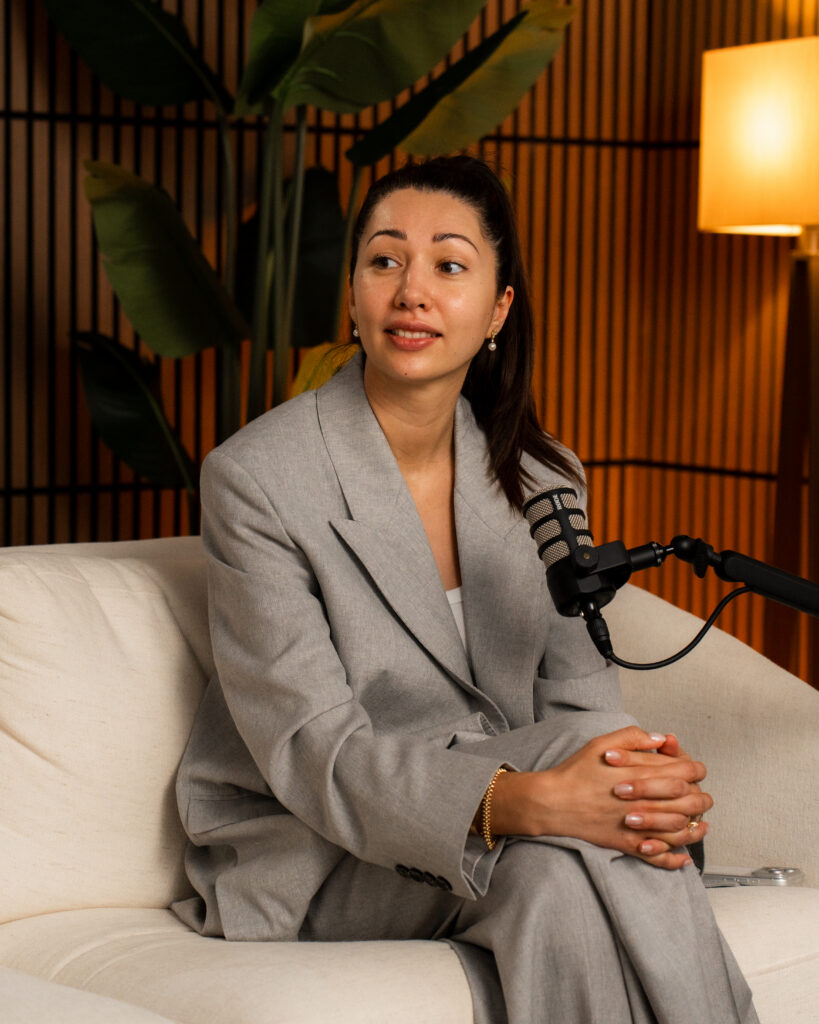
Anastasia Khodzhaeva is a biologist, biohacker, and entrepreneur who began her career in biomedical research before co-founding Young Goose — the first biohacking skincare brand. As co-founder and co-CEO, she has built the brand around the hallmarks of aging, bridging longevity science and skincare in a way the industry had never seen. Anastasia brings the same scientific rigor to everything she builds, and her work continues to shape how a new generation thinks about cellular health, beauty, and how we age.
Q&A
What inspired you to build Young Goose, and how did your background in biology shape the way you approach skin and health?
My husband Amitay and I founded Young Goose in 2017 because we saw a gap that felt obvious once you looked at it from a biology perspective. The entire skincare industry was built around treating the surface of the skin, hydration, exfoliation, collagen stimulation, while the science of aging was advancing in a completely different direction. Longevity researchers were studying cellular energy, DNA repair, autophagy, senescence. None of that was showing up in the products on the shelf. We decided to build a brand that treats skin as a biological system, not a canvas. Every product we make is mapped to the twelve hallmarks of aging. That framework is the foundation of everything we do.
We talk about mitochondria as the drivers of cellular energy. Where are you seeing the greatest impact on women’s health today and how is that showing up in how women feel, function, and age?
Mitochondrial health is the layer underneath almost everything women experience as they age. Fatigue, slower recovery, skin that doesn’t bounce back the way it used to, reduced resilience to stress. These are not separate problems. They are downstream signals of the same thing: cells that don’t have enough energy to do their jobs. When we formulate around mitochondrial support, the results show up in skin first because skin is one of the most metabolically active tissues in the body. But the conversation is bigger than skincare. Women are starting to connect the dots between their energy levels, their hormonal shifts, and their cellular health. That connection is where the real progress is going to happen.
Postpartum changes, especially to skin, are often overlooked. In your recent podcast, you spoke about disruptions like sleep and how your skin has been affected. What have you experienced, and what’s helped you adapt?
Postpartum is one of the most honest stress tests your skin will ever go through. Sleep deprivation, hormonal shifts, the sheer physical demand of recovery. My skin responded to all of it. I noticed changes in texture, in resilience, in how quickly my skin recovered from a bad night. What helped me was not a new product. It was understanding the biology of what was happening. Sleep deprivation reduces NAD+ availability. Hormonal shifts alter collagen signaling. Stress increases inflammation. Once I understood the mechanisms, I could be more intentional about supporting them, both through what I put on my skin and how I structured my recovery. The protocol I follow is the same one we built into our products: restore energy first, then let the skin do what it already knows how to do.
The science on mitochondrial health, on cellular energy, on the biological hallmarks of aging, this is not speculative anymore. It is real, published, and actionable. But most of it never reaches the people it could help.
The industry often talks about “anti-aging.” How do you think about shifting that conversation toward prevention, resilience, and long-term cellular health?
“Anti-aging” was never an honest term. It promised to slow down aging. What it actually delivered was improved appearance. Those are not the same thing. Retinol speeds cell turnover. Vitamin C brightens. These are real mechanisms, but none of them modify the biology of aging in any meaningful way. “Longevity” is the replacement, and I think it’s the right one, but only if the industry earns it. At Young Goose, we think about three pillars: appearance (what the mirror shows you today), resilience (your skin’s barrier and stress tolerance), and longevity (the cellular trajectory underneath). Most products only address the first pillar and call it the third. We are trying to address all three, starting with the biology.
Young Goose focuses on supporting the skin at the cellular level. How should women start thinking about skin as a reflection of overall cellular and mitochondrial health, not just appearance?
The simplest reframe is this: your skin is not a separate organ from the rest of your biology. It is the most visible one. When your mitochondria are functioning well, you have the cellular energy for collagen production, for barrier maintenance, for repair after UV exposure. When they decline, every one of those processes slows down, and the result is what you see in the mirror. So instead of asking “what product will make my skin look better,” the better question is “what is my skin telling me about my cellular health?” If your skin is losing resilience faster than it should, that’s information. It’s a signal worth paying attention to, not just covering up.

What drew you to Countdown, and why does this mission feel urgent to you right now?
Countdown is doing something I deeply believe in: connecting the science of longevity with the women who need it most. The urgency comes from the gap between what the research already knows and what most women have access to. The science on mitochondrial health, on cellular energy, on the biological hallmarks of aging, this is not speculative anymore. It is real, published, and actionable. But most of it never reaches the people it could help. I want to be part of closing that gap, through what we build at Young Goose and through conversations like this one.
Countdown is doing something I deeply believe in: connecting the science of longevity with the women who need it most.
What’s the biggest gap in women’s health today that mitochondrial science has the potential to change?
The biggest gap is that women are still being told that the changes they experience with age are inevitable and cosmetic. They are neither. The decline in mitochondrial function that accelerates around perimenopause and menopause affects energy, cognition, skin, recovery, and resilience. These are not separate problems with separate solutions. They are one problem with one root: cellular energy. Mitochondrial science gives us a framework for understanding that root and intervening at the level where it matters. The potential is enormous, but only if we stop treating the symptoms and start addressing the biology.

If you could leave the audience with one message about why mitochondrial health should matter to every woman, what would it be?
Everything your body does requires energy. Every repair process, every immune response, every moment of recovery. Mitochondria produce that energy. When they decline, everything downstream declines with them. Supporting mitochondrial health is not a luxury or a biohacking trend. It is the most foundational investment you can make in how you feel, how you function, and how you age. Start there. Everything else follows.