Aging cells that refuse to die run on faulty mitochondria. New research shows how, and why it could change the way we treat them.
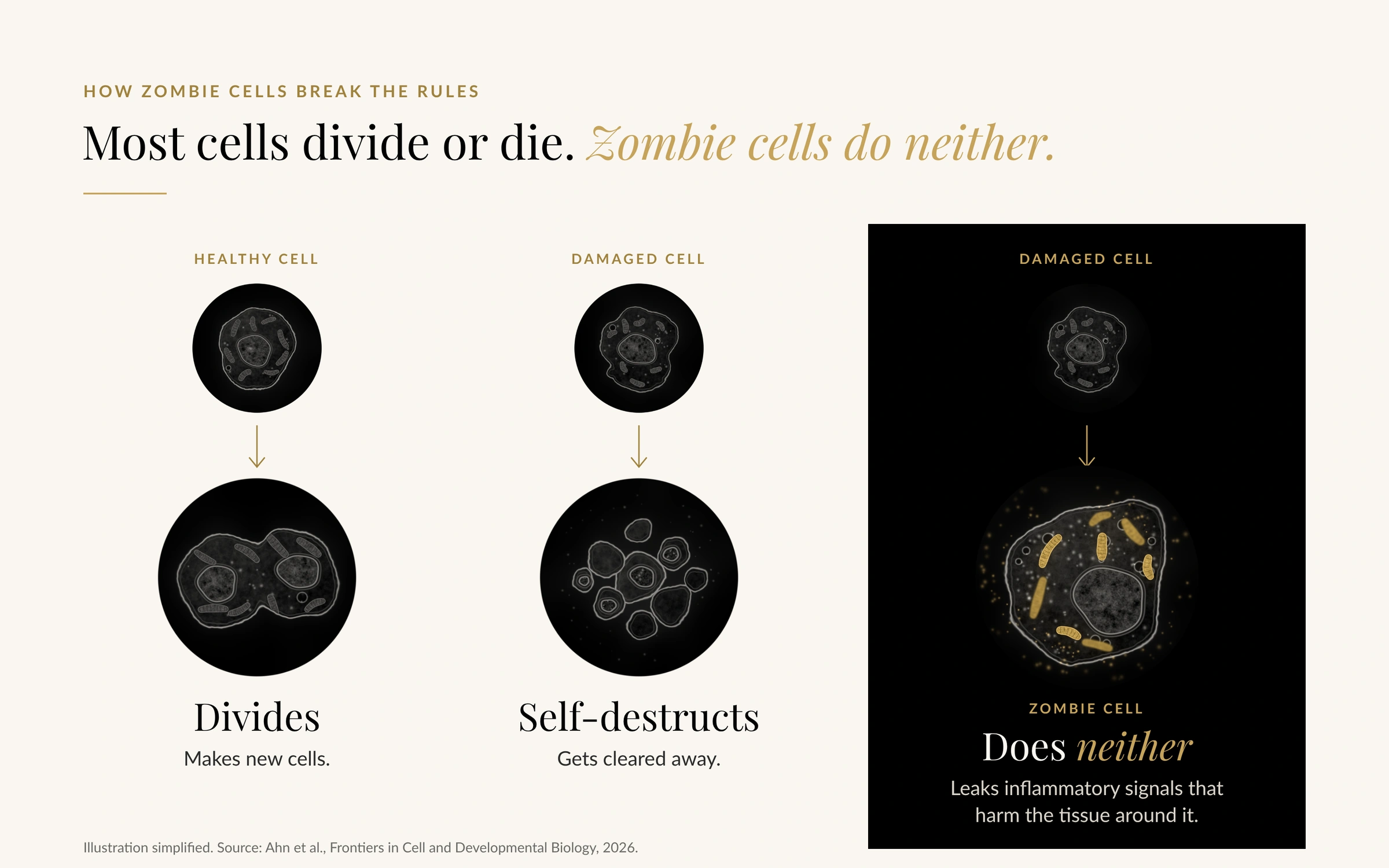
Most cells follow a life cycle. Healthy cells divide to make new ones, and worn-out or damaged cells self-destruct and get cleared away.
But some of your cells don’t follow these rules. Scientists call them senescent cells. Most people know them by a better name: zombie cells.
Instead of dividing or dying, zombie cells stay busy, sending out inflammatory signals that can harm the tissue around them.
As we age, zombie cells build up. That matters because each one keeps leaking inflammation, and that kind of chronic inflammation is linked to many diseases of aging. In mice, a buildup of zombie cells shortened healthy lifespan and sped up decline in the kidneys, heart, and fat. Clearing them out helped the animals live longer and stay healthier.
For years, scientists focused on damaged DNA as the trigger that turns healthy cells into zombies. Now research is pointing to another player: the mitochondria. These are the tiny structures inside nearly every cell that turn food and oxygen into the energy the cell runs on. Mitochondria, it turns out, help create zombie cells, keep them inflamed, and even decide whether drugs can kill them.
Faulty Power Locks the Cell In
Why do zombie cells stay stuck instead of recovering? In a 2010 study published in Molecular Systems Biology, researchers at Newcastle University in the UK found that once a damaged cell stops dividing, its mitochondria start leaking harmful molecules that cause fresh damage. That keeps the cell’s alarm ringing, so it never goes back to normal.
The same group then asked how much of the zombie cell’s harmful behavior depends on its mitochondria. In a 2016 study published in The EMBO Journal, they removed the mitochondria from zombie cells grown in the lab. Without them, the cells largely stopped pumping out inflammatory signals. In other words, the damage zombie cells do runs on their mitochondria.
Faulty mitochondria can also push healthy cells into the zombie state on their own. In a 2016 study published in Cell Metabolism, researchers switched off proteins that help keep mitochondria running in healthy human cells. The cells stopped dividing and turned into zombies. The trigger was a shift in the balance of NAD+, a molecule cells need to make energy.
The same team then studied mice bred with mutations in their mitochondrial DNA, which age faster than normal mice. Zombie cells piled up in these mice too. In lab tests, the signals these cells sent out interfered with the formation of fat cells, a hint at how they can disrupt the tissue around them.
That could matter for people with mitochondrial disease. The researchers said the findings could be relevant to mitochondrial diseases and to age-related conditions involving faulty mitochondria, such as some forms of Parkinson’s.
The Alarm and the Key
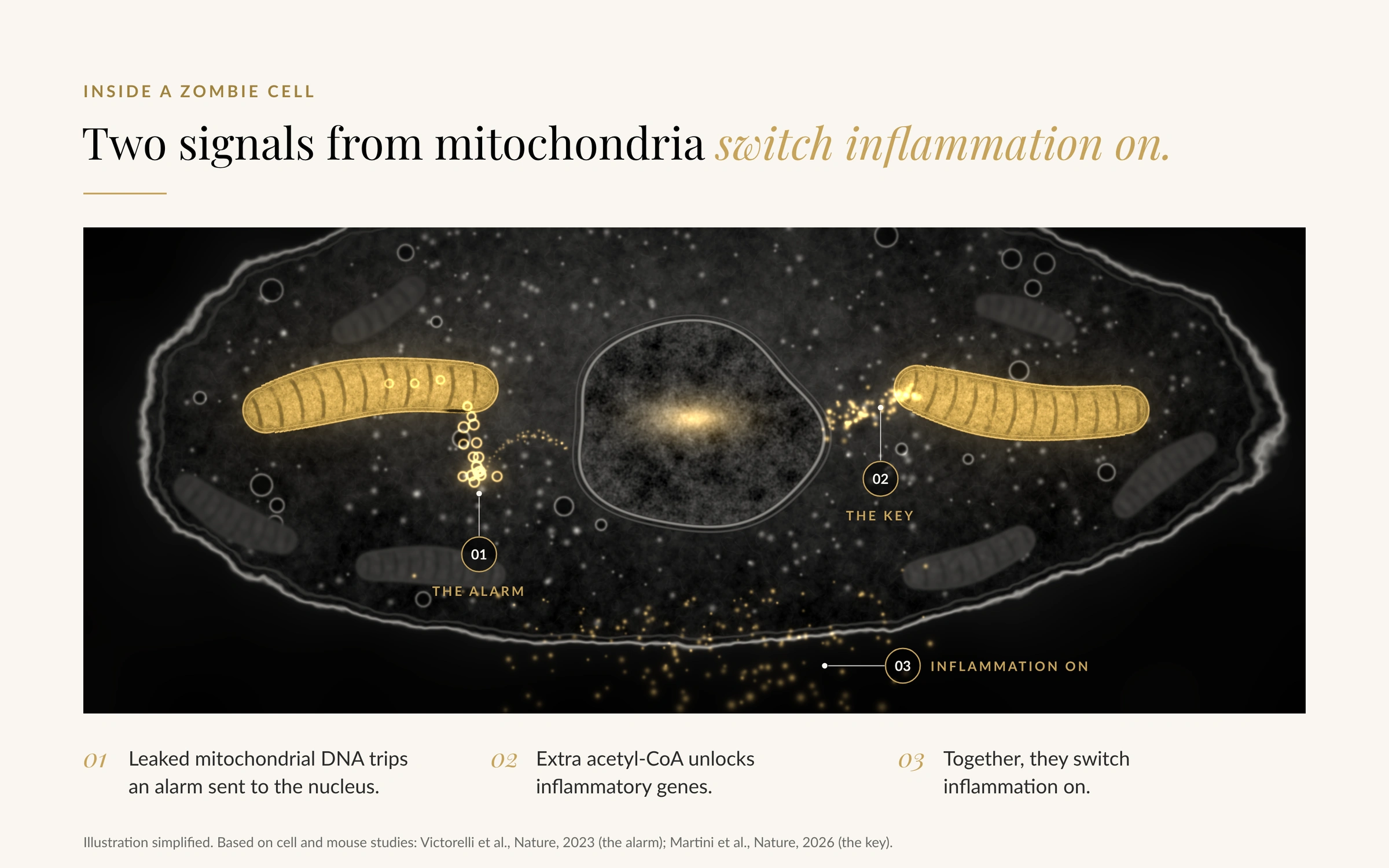
New research shows zombie cells’ mitochondria send two signals that drive inflammation. You can think of one as an alarm and the other as a key.
The alarm. In a 2023 study published in Nature, researchers at Mayo Clinic and the University of Glasgow found that zombie cells’ mitochondria spring small leaks, which allows bits of mitochondrial DNA to escape. The cell mistakes that DNA for a virus and sounds an inflammatory alarm: it switches on its defenses and starts pumping inflammatory signals into the tissue around it. When the team blocked the leaks in older mice, it reduced inflammation and slowed frailty.
The key. The alarm alone doesn’t explain how intense the inflammation gets. This summer, researchers at Mayo Clinic and Sanford Burnham Prebys Medical Discovery Institute published a study in Nature looking for the missing piece. They found it in the mitochondria too. Zombie mitochondria overproduce a molecule called acetyl-CoA, which unlocks the cell’s inflammation genes so they can switch on. The alarm tells the cell to sound off; the key lets it do so at full volume.
“We found that inflammatory signaling alone isn’t enough,” Helene Martini, the study’s first author, said in a Mayo Clinic news release. “The cells also need a metabolic signal from mitochondria that changes how inflammatory genes are turned on.”
In the same study, the team tested a drug that cuts off this supply of acetyl-CoA. In mice, it reduced inflammation and improved health during aging.
Why Zombie Cells are Hard to Kill
The best-known way to kill zombie cells is with drugs called senolytics. So far, these drugs have been tested mostly in lab and animal studies, plus a handful of small human trials. Many of them work by flipping a self-destruct switch that sits on the mitochondria.
But senolytics don’t kill every zombie cell. In a 2026 study published in Nature Aging, researchers at the University of Osaka in Japan tested 21 senolytics on zombie cells grown in the lab. Even the best drugs left some cells alive.
The surviving cells had one thing in common: healthier mitochondria. These cells were unusually good at clearing out their damaged mitochondria and keeping the rest in working order. Because the drugs’ self-destruct switch sits on the mitochondria, cells with sturdier mitochondria were harder to kill.
That gave the researchers an idea. If healthy mitochondria protect zombie cells, what happens when you make those mitochondria work harder? They tested this in mice, using a ketogenic diet or a type of diabetes drug to put the mitochondria under more strain. The extra workload helped the senolytics clear more zombie cells. It’s an early finding, but a promising one.
No zombie-cell treatment is approved yet, and human trials are still few and small. Early results suggest senolytics may help only people with a heavy zombie-cell load.
The mitochondrial findings point to a gentler approach: calming zombie cells instead of killing them, for example by helping cells clear out damaged mitochondria.
So far, nearly all of that evidence comes from cells and animals, including early work on urolithin A, a compound made by gut bacteria.
What This Means for You
There’s no pill you can take to kill zombie cells. But you don’t have to wait for a drug to start looking after your cells. Here’s what you can do now.
Move. In a small study of older adults, regular strength and endurance training lowered blood markers of zombie cells. Participants also got stronger and felt less tired.
Be skeptical of “senolytic” supplements. The human evidence is still thin. Talk to your doctor before trying anything sold as a zombie-cell fix.
Follow the trials. Dozens of studies are under way, and you can search them at ClinicalTrials.gov.
Eat foods that fuel urolithin A. Pomegranates, berries such as raspberries, and nuts such as walnuts contain compounds that gut bacteria turn into urolithin A. In lab studies, urolithin A quieted the inflammatory signals coming from zombie cells, though that hasn’t been shown in people yet. How much you make depends on your gut bacteria, and some people make none at all.
For years, the main plan for zombie cells has been to kill them. The newest science suggests the better target may be their power supply.
____________________________________________________________________________
References
- Victorelli S, et al. Apoptotic stress causes mtDNA release during senescence and drives the SASP. Nature. 2023;622(7983):627–636.
- Ahn M, Yoon S-J, Seo JH. Mitochondrial regulation of cellular senescence heterogeneity. Frontiers in Cell and Developmental Biology. 2026;14.
- Baker DJ, Childs BG, Durik M, et al. Naturally occurring p16Ink4a-positive cells shorten healthy lifespan. Nature. 2016;530(7589):184–189.
- Mayo Clinic News Network. Scientists identify new mitochondrial pathway linked to harmful inflammation in aging. News release. July 29, 2026.
- Passos JF, Nelson G, Wang C, et al. Feedback between p21 and reactive oxygen production is necessary for cell senescence. Molecular Systems Biology. 2010;6:347.
- Wiley CD, Velarde MC, Lecot P, et al. Mitochondrial dysfunction induces senescence with a distinct secretory phenotype. Cell Metabolism. 2016;23(2):303–314.
- Martini H, et al. Mitochondrial metabolism and epigenetic crosstalk drive SASP. Nature. 2026;656:980–992.
- Wakita M, Ito K, et al. Comparative analysis of senolytic drugs reveals mitochondrial determinants of efficacy and resistance. Nature Aging. 2026;6:316–328.
- Correia-Melo C, Marques FDM, Anderson R, et al. Mitochondria are required for pro-ageing features of the senescent phenotype. EMBO Journal. 2016;35(7):724–742.
- Buck Institute for Research on Aging, via ScienceDaily. Signaling from dysfunctional mitochondria induces cellular senescence with a distinct secretory phenotype. News release. January 13, 2016.
- Sanford Burnham Prebys. Altered metabolism in zombie-like cells helps promote destructive inflammation as we age. News release. August 2026.
- Khosla S. Translating senolytics from mice to humans. Innovation in Aging. 2025;9(Suppl 2):igaf122.679.
- Farr JN, et al. Effects of intermittent senolytic therapy on bone metabolism in postmenopausal women: a phase 2 randomized controlled trial. Nature Medicine. 2024;30(9):2605–2612.
- Barkovskaya A, et al. Mitigating pro-inflammatory SASP and DAMP with urolithin A: a novel senomorphic strategy. Aging Cell. 2025.
- Englund DA, et al. Exercise reduces circulating biomarkers of cellular senescence in humans. Aging Cell. 2021.
- Mayo Clinic News Network. Exercise reduces indicators of senescent cells in the body. News release. June 9, 2021.
- Shetty SS, Shetty S, Kumari NS. Therapeutic efficacy of gut microbiota-derived polyphenol metabolite urolithin A. Beni-Suef University Journal of Basic and Applied Sciences. 2024;13:31.