Researcher and Countdown Scientific & Medical Advisory Board member Tyler LeBaron, PhD, explains what studies suggest about hydrogen and the power plants in our cells.
When I set a new GUINNESS WORLD RECORDS™ title for the fastest half marathon carrying a 40-pound pack on my back. The race was the first challenge in Countdown’s Energy Project. In addition to training runs, strength work, careful nutrition, and recovery, preparing for the race also included something you might be less familiar with: molecular hydrogen therapy.
Molecular hydrogen, or H₂, consists of two hydrogen atoms bonded to each other, forming a gas. You may have heard about it in the context of hydrogen water, which is simply ordinary water with H₂ gas dissolved in it. That dissolved gas is separate from the hydrogen atoms that are part of every water molecule (H₂O). Hydrogen therapy is generally done by consuming hydrogen water, inhaling 1–4% hydrogen gas, or both.
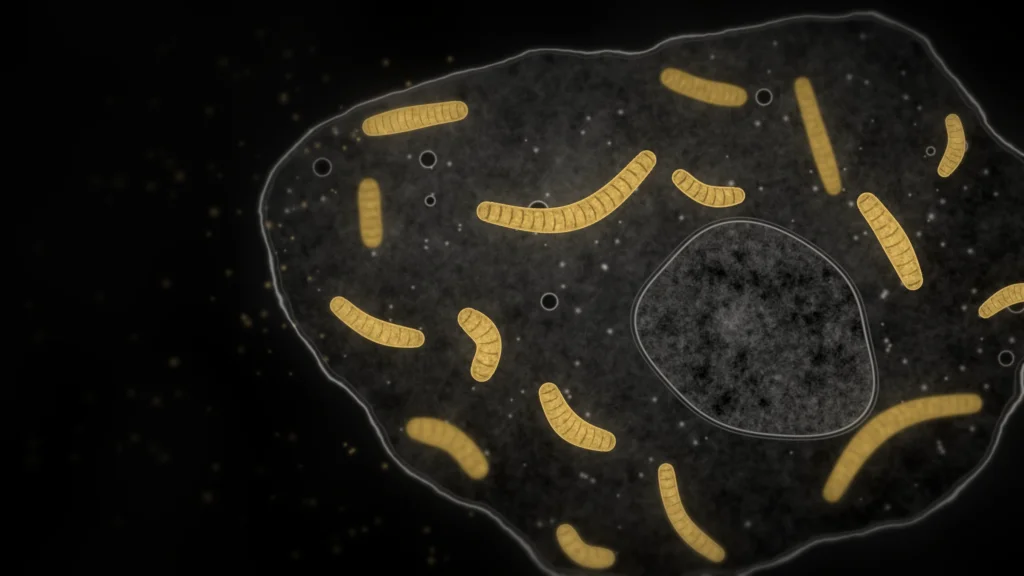
As an athlete, molecular hydrogen researcher, and executive director of the Molecular Hydrogen Institute, I’m interested in what happens after that H₂ enters the body. My work explores how it interacts with mitochondria, the ‘engines’ inside our cells that produce ATP, the fuel that powers cellular activity. Emerging findings suggest hydrogen influences how mitochondria respond to stress and activate processes that help cells adapt.
That’s the question I care about most: whether these effects in cells translate into anything meaningful for people. My research and work by other scientists are helping us understand those mechanisms, while human studies are testing what they mean for health and performance.
Here are five things to know about molecular hydrogen and its effects on mitochondrial health.
Your body already produces molecular hydrogen
Certain bacteria in your gut produce molecular hydrogen as they ferment carbohydrates, including fiber your own digestive enzymes can’t break down. Releasing H₂ helps those bacteria keep fermenting, which is how they get energy from what you eat.
That raises a question: Could the hydrogen these microbes produce contribute to some of fiber’s health benefits, including the lower risk of early death seen in people who eat the most fiber?
In one rat study, diets supplemented with pectin or resistant starch increased hydrogen production in the gut and hydrogen levels in blood traveling to the liver. The rats also had less liver injury after blood flow was temporarily interrupted and restored, suggesting that hydrogen could contribute to fiber’s protective effects. Whether it provides similar protection in people remains an open question.
Takeaway: Hydrogen is already part of the relationship between your diet and your gut microbes. Understanding its role could help explain how that relationship influences health beyond digestion.
Hydrogen may help protect cells while preserving the signals they need
Much of the early interest in hydrogen centered on its potential to act as an antioxidant, helping protect DNA, proteins, and cell membranes from damage caused by reactive oxygen species, or ROS. ROS are unstable, oxygen-containing molecules, including free radicals, that cells make as a normal byproduct of metabolism, including energy production in mitochondria. But ROS also have useful roles. Some act as chemical signals that help cells respond to stress and activate defenses.
During exercise, for example, certain ROS help signal muscles to adapt to the demands of training. Suppressing those signals could interfere with the changes that make muscles better equipped for the next workout.
That raises an important question for hydrogen research: Can H₂ reduce oxidative damage without disrupting the ROS signals cells need? In a 2007 study published in Nature Medicine, researchers found that 2% hydrogen inhalation reduced hydroxyl radicals, a particularly damaging type of ROS, without reducing certain other molecules involved in normal cellular signaling. Hydrogen also reduced brain injury in a rat model of stroke. Those findings suggested that its antioxidant effects could be selective.
But the antioxidant explanation has a gap. Hydrogen reacts with hydroxyl radicals relatively slowly, and it has effects throughout the body. In a 2019 review, my colleagues and I argued that neutralizing radicals can’t fully explain what hydrogen does, and that something else must be going on.
Takeaway: Hydrogen helps limit oxidative damage while preserving useful cellular signals.
Hydrogen may influence how mitochondria adapt to stress
Hydrogen may do more than preserve the signals cells need. Our research suggests it triggers a stress response within mitochondria, activating systems that help keep their proteins functioning properly.
In a 2025 study I coauthored in Redox Biology, we found that hydrogen temporarily slowed part of the mitochondria’s energy-producing machinery in laboratory experiments. That disruption activated a cellular maintenance response that helps keep mitochondrial proteins in working order.
Temporarily slowing the machinery that produces cellular energy might sound counterproductive. But that challenge may prompt cells to step up maintenance of their mitochondria. This is an example of hormesis: a manageable stress activates processes that help cells adapt. Researchers still need to establish whether hydrogen’s effects on these maintenance systems improve health or performance in people.
Takeaway: Hydrogen activates the cell’s own mitochondrial maintenance systems, helping explain how it supports mitochondrial health.
Molecular hydrogen shows promise for metabolic health and exercise
In a 24-week trial I coauthored, 60 adults with metabolic syndrome, a cluster of risk factors that raise the likelihood of heart disease and diabetes, received hydrogen-rich water or a placebo. Those drinking hydrogen-rich water showed improvements in blood glucose, cholesterol, and several markers of inflammation. These were changes in health indicators. The study didn’t establish whether hydrogen prevents disease.
For exercise, a 2024 analysis of 27 publications involving 597 participants found that hydrogen reduced perceived exertion, meaning exercise felt less demanding, and lowered blood lactate, a byproduct of intense effort. It did not find a significant overall improvement in aerobic endurance. Feeling that a workout is easier and being able to sustain it longer are different benefits.
Takeaway: Human research gives us reasons to keep investigating hydrogen. Larger, repeated studies will help establish which benefits are reliable, who experiences them, and at what dose.
The delivery system matters
Hydrogen-rich water and hydrogen inhalation devices deliver the same molecule in different ways: one through drinking, the other through breathing hydrogen-containing gas, typically through a mask or nasal tubing. How much H₂ reaches the body, and for how long, matters when interpreting its effects.
For water, the dose depends on how much H₂ is dissolved in it and how much you drink. In general, when it comes to hydrogen water, higher doses/concentrations likely have a higher likelihood of providing benefits and possibly more of them. However, more clinical research is needed to determine those benefits and optimal doses.
For inhalation, the challenge is knowing how much hydrogen you actually breathe in. In a 2026 modeling study I coauthored, we demonstrated that device output alone doesn’t reliably predict that exposure. Surrounding air dilutes the hydrogen, and your breathing pattern, such as how fast you inhale and whether you breathe through your nose or mouth, affects the concentration you take in. Two people using the same setting could receive different concentrations.
Accurately measuring hydrogen is only part of the challenge. We also need to understand how much produces a benefit. The studies we reviewed don’t point to a single best amount. Comparisons in animals found 2–4% inhaled hydrogen worked better than 1%. No human study has yet pinned down the optimal concentration, which is likely context dependent.
However, 2-4% seems to be the ideal range, which fortuitously is below the flammability level. Hydrogen can catch fire in air at concentrations above about 4%. This is problematic with inhalation systems that use a nasal cannula and provide high concentrations of hydrogen. It means that the concentration in the nose is above the flammability level of 4%, but by the time it is diluted during inhalation, it may be less than 1% in your lungs.
Takeaway: If hydrogen therapy is something you are interested in, look for products whose makers explain how they measure the hydrogen you receive and how it compares with amounts used in human studies. If that information isn’t available, you can’t assume the research findings apply to the product.

Stay curious, stay skeptical
Within about a decade, hydrogen will be widely recognized as a therapeutic gas. What will get us there is exactly what’s missing now: bigger trials, results that hold up when repeated, and a clearer sense of the right dose.
Hydrogen is also not a substitute for the basics. Whatever it turns out to do for mitochondria, it works on top of what we already know supports them: exercise, good food, sleep, and avoiding smoking and excess alcohol. Training is my foundation. Hydrogen is one tool I add to it.
If you decide to try hydrogen, ask how much you are actually getting and how it was measured. Avoid devices that put out highly concentrated hydrogen gas, which have been linked to serious injuries in Japan. And if you are managing a health condition, talk to your doctor first.
Whether to try it is your decision. If you want proof first, the evidence is not there yet, and waiting is reasonable. If you want to experiment carefully, that is reasonable too. Either way, it is fine not to know yet. That uncertainty is exactly why the research matters.
Dr. LeBaron is co-founder and chief scientific officer of InhaleH₂, a hydrogen inhalation company. Inhale H2 is the founding sponsor of The Energy Project.